YOUR PROPULSION EXPERTS

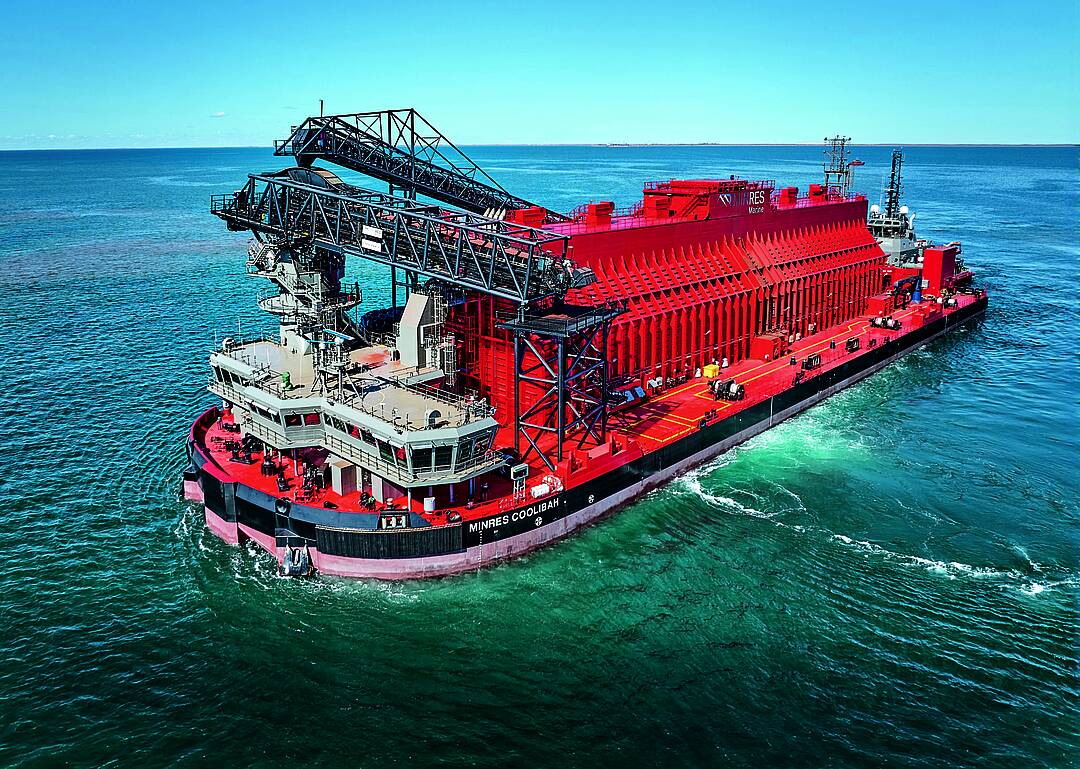
Located in Western Australia, the Onslow Iron project aims to set new standards in mining through world-first autonomous road trains, industry-leading dust-free transport and an innovative shipping concept – powered by SCHOTTEL.
Amidst the remote expanses of the Pilbara region in Western Australia, where red sand dunes and rugged rock formations dominate the scenery, one of Australia’s largest and most innovative iron ore projects is being implemented: Mineral Resources’ (MinRes) Onslow Iron project. Utilizing cutting-edge technologies and an innovative mine-to-ship supply chain, the project is set to unlock around 35 million tonnes of previously untapped ore deposits annually over a period of more than 30 years, while minimizing the environmental footprint and increasing efficiencies of mining.
But what exactly makes this supply chain so special? It all starts with the extraction of ore at the Ken’s Bore mine site, located about 150 kilometres inland from the coast. Here, drilling and blasting activities are conducted, before the ore is processed in modular crushing plants, which significantly reduce dust and noise emissions compared to conventional technologies. A dedicated truck load-out facility sets the haulage operation in motion, with autonomous road trains making the journey to the Port of Ashburton near the town of Onslow on a private purpose-built haul road. Currently, around 170 of these trucks are in operation, each with a load capacity more than 300 tonnes. Upon arrival at the port, the ore is automatically unloaded and stored in an enclosed 220,000-tonne capacity storage shed. Negative pressure in the facility prevents ore dust from spreading into the air, protecting both the environment and employees. The ore is then reclaimed onto an enclosed conveyer belt and loaded into transhippers, which transport it to awaiting Capesize bulk carriers anchored 40 kilometres offshore.

The innovative shipping concept forms the actual core of the supply chain. It was primarily developed to avoid the construction of a deep-water port for loading the bulk carriers, which would have impacted both the project’s sustainability and economic viability. Instead, barges with a capacity of around 20,000 tonnes are used. Even when fully loaded, they have an extremely shallow draught of only seven metres. To enhance their manoeuvrability, the barges are linked to powerful tugs – forming a transhipper – via an articulated tug and barge arrangement (ATB). The control of the tugs is managed by a unique steering concept: as visibility from the tugs while pushing the vessels is limited due to their lower height, they are controlled from the wheelhouse of the barges.
To implement a project of this magnitude, MinRes needs strong partners – one of them is SCHOTTEL.
“MinRes commenced discussions with SCHOTTEL early in the design stage of the project. The combination of SCHOTTEL PumpJets and SCHOTTEL Controls for the tug Azimuthing Stern Drives has been fundamental to the success of the transhipping operation.”
Jeff Weber – Executive General Manager MinRes Marine
All seven transhippers – named after the islands off the Pilbara coast – are being equipped with SCHOTTEL propulsion systems. To ensure the lowest possible draught, which is essential for loading the transhippers near the coast, two SCHOTTEL PumpJets type SPJ 320 have been selected for each ship. The modern shallow-water propulsion unit provides full thrust in all directions, even at minimum immersion depths. The 123-metre-long and 36-metre-wide barges are being built at COSCO Shipping Heavy Industry in Zhoushan and Guangdong, China. Five of the seven transhippers have already commenced operations at the Port of Ashburton.
When it comes to the propulsion systems of the tugs, MinRes also relies on SCHOTTEL: the two newbuilds, which are currently under construction at COSCO Shipping Heavy Industry, are equipped with two SCHOTTEL RudderPropellers type SRP 610 and one TransverseThruster type STT 1 each. For the remaining tugs, MinRes is using existing vessels – including three with SCHOTTEL RudderPropellers – which have been specially converted for their new operation purpose.
The unique control system mentioned above was also developed in close collaboration with SCHOTTEL. It allows any tug – even those without SCHOTTEL propulsion – to be linked to any barge, ensuring that all transhippers can continue to operate even during downtimes or maintenance of a tug. “Since the propulsion units of the tugs have different features – for example, the new buildings are powered by an electric motor – we would normally need several different control panels in each transhipper wheelhouse. However, we have developed a much more practical solution,” explains Björn Bender, Sales Manager Modernization & Conversion at SCHOTTEL. Instead of using multiple panels for the different thruster types, each transhipper is equipped with one identical panel. A logic system detects which tug is linked to the barge and only activates the functions on the panel that the thruster actually supports. “With this innovative control concept, we achieve maximum flexibility in the connection between barge and tug,” concludes Björn Bender. “This ensures that the Onslow Iron project is well-equipped for reliable, efficient and long-term operation."